
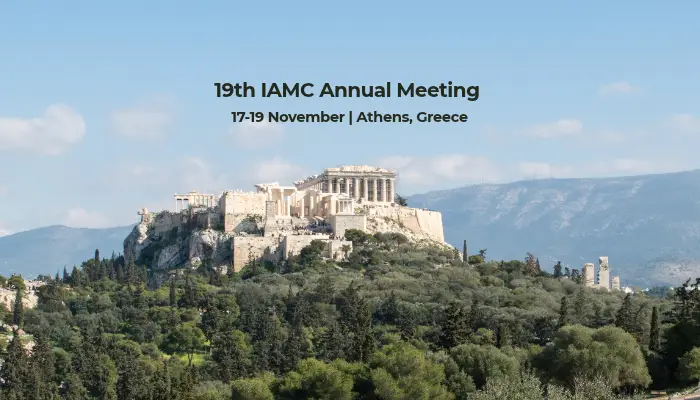
Nature restoration brings ecological, economic and societal benefits, and ECONATURES is building the evidence to measure them. ECONATURES will present its integrated approach to nature restoration at the 19th IAMC Annual Meeting, held 17–19 November 2026 at the Eugenides Foundation in Athens. On 18 November, ECONATURES co-hosts a parallel session on Land & Biodiversity, one of the first events from ECONATURES.
About the IAMC Annual Meeting
The IAMC Annual Meeting is a scientific meeting for peer sharing and vetting, open to researchers from organisations involved in integrated assessment modelling and their collaborators. Participants share developments in methods, models and data. This year’s edition takes place in Athens, with online attendance available for all sessions.
About ECONATURES
ECONATURES aims to strengthen the evidence for nature restoration by assessing its ecological, economic and societal benefits and supporting better-informed policy decisions.
The project brings together ecological knowledge and economic modelling to understand how restoration interacts with climate action, land use and sustainable development.
Two models, one integrated view
E3-Modelling (E3M) contributes to ECONATURES through two models:
- OPEN-PROM–MAgPIE explores the links between the energy transition, land use and biodiversity.
- GEM-E3 assesses economy-wide and socioeconomic impacts.
Together, these approaches help identify synergies, trade-offs and effective restoration pathways.
The ECONATURES session, 18 November
The Land & Biodiversity session, co-hosted by ECONATURES and chaired by Dr Anastasis Giannousakis, will showcase this integrated approach and invite discussion on how the modelling community can better support nature restoration policies.
Meet the session chair
Dr Anastasis Giannousakis is Lead Modeller in the Global Energy Markets & Integrated Assessment Modelling group at E3-Modelling (WSP). He has more than 16 years of experience in energy-economy-climate modelling and holds a PhD in Climate Economics from the Technical University of Berlin. His research focuses on the development and application of large-scale energy system and integrated assessment models to analyse decarbonisation pathways, low-carbon fuels, bioenergy and climate mitigation under uncertainty.
How to follow
Only In-person places are full, but online registration is still open: secure your post
